
General Research Interests
• Ultrafast photonics;
• Optical signal processing;
• Optical pulse shaping;
• High-speed signal characterization and measurement;
• Fourier optics and imaging;
• Quantum optics;
• Optical computing;
• Optical telecommunications;
• All-fiber technologies;
• Integrated waveguide devices;
• Silicon photonics;
• Fiber/waveguide Bragg and long-period gratings;
• Ultrafast information processing;
• Light interferometry;
• Microwave photonics;
• Ultra-broadband microwave engineering.
Overview of Scientific Contributions and Ongoing Research Activities
(For each of the listed items, some samples of relevant recent contributions are provided and described in more detail)
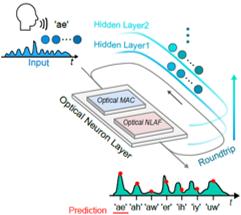 Programmable All-optical Neural Network with 40k Connections
Photonic neural networks can perform linear mixing with light at low latency and energy, but practical engines still face two key bottlenecks: nonlinear activation often requires optoelectronic conversion, and scalable programmable connectivity is limited. In our recent work, we propose and demonstrate a programmable photonic neural engine that combines all-optical nonlinear activation with 40,000 connections.
Programmable All-optical Neural Network with 40k Connections
Photonic neural networks can perform linear mixing with light at low latency and energy, but practical engines still face two key bottlenecks: nonlinear activation often requires optoelectronic conversion, and scalable programmable connectivity is limited. In our recent work, we propose and demonstrate a programmable photonic neural engine that combines all-optical nonlinear activation with 40,000 connections.
The engine uses a reconfigurable photonic fabric to implement many weighted optical connections and applies the nonlinearity directly in the optical domain—avoiding conversion to electronics while allowing the connectivity to be reprogrammed for different neural tasks. The key result, 40,000 connections together with all-optical nonlinear activation in a programmable engine, addresses two major scalability bottlenecks at once and points toward scalable, low-overhead photonic processors for AI inference, optical signal processing, and neuromorphic photonic computing.
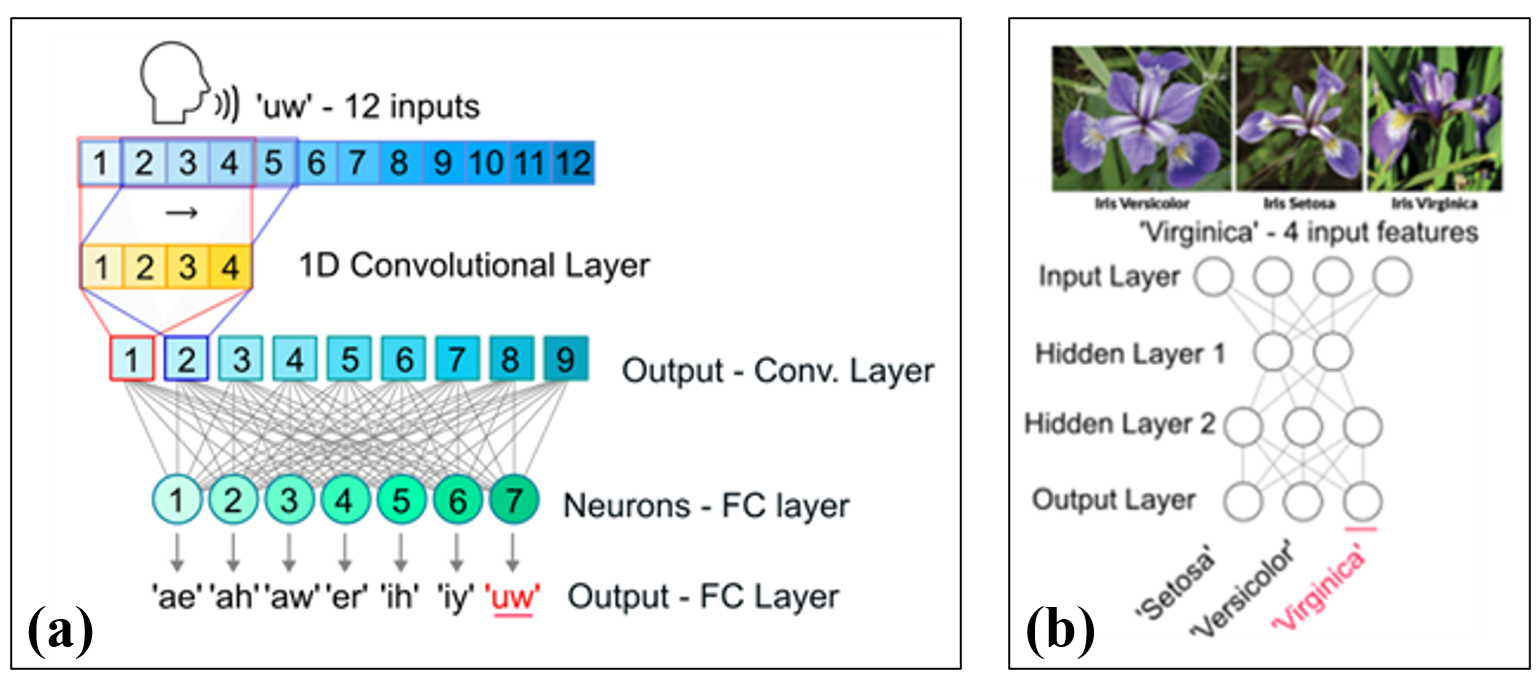
Figure: (a) One-dimensional (1D) convolutional neural network (CNN) for the classification of 7 vowels, including one convolutional layer and one fully connected (FC) layer. (b) A three-layer deep neural network with 8 neurons for recognition of Iris plants (3 classes).
 Quantum State Generation and Processing
We conduct active research in quantum optics, particularly on phase-only transformations for the generation and processing of quantum states [1]. Temporal phase modulation and spectral phase filtering are especially important for quantum processing because they provide a versatile framework that is inherently low-loss, a critical requirement in quantum information where signals cannot be amplified.
Quantum State Generation and Processing
We conduct active research in quantum optics, particularly on phase-only transformations for the generation and processing of quantum states [1]. Temporal phase modulation and spectral phase filtering are especially important for quantum processing because they provide a versatile framework that is inherently low-loss, a critical requirement in quantum information where signals cannot be amplified.
These manipulations can be interpreted as approximations to unitary transformations on a quantum state (up to device insertion loss), enabling wavefunction shaping, quantum-state generation and processing, as well as quantum-state characterization and detection. Building on this work, we showed the generation of high-dimensional frequency-domain quantum states using telecommunications and integrated-photonics components [2], depicted in Fig. (a). In (a1), we show the experimental setup for high-dimensional state generation and control. A passively mode-locked laser was spectrally filtered to excite a single resonance of an integrated microring resonator. Spontaneous four-wave mixing (SFWM) (left inset) generated photon pairs (signal and idler) symmetrically about the pump and in a quantum superposition of frequency modes defined by the resonances. Programmable filters and a modulator were used to manipulate the state (right inset: frequency sideband generation vs frequency ν), before detection by two single-photon counters. (a2) Quantum-interference characterization of qudits with D = 4 was performed by projecting the states onto superpositions of 4 frequency modes with different phases. A raw visibility of 86.4% (without background subtraction) was obtained, exceeding the threshold of 81.7% required to violate a Bell inequality for this 4-dimensional state. (a3) Exploiting arbitrary, independent projection measurements on signal and idler, we performed full quantum-state tomography to reconstruct the density matrix of the entangled qudit states, achieving a fidelity of 76.6% for D = 4,in very good agreement with the expected maximally entangled states.
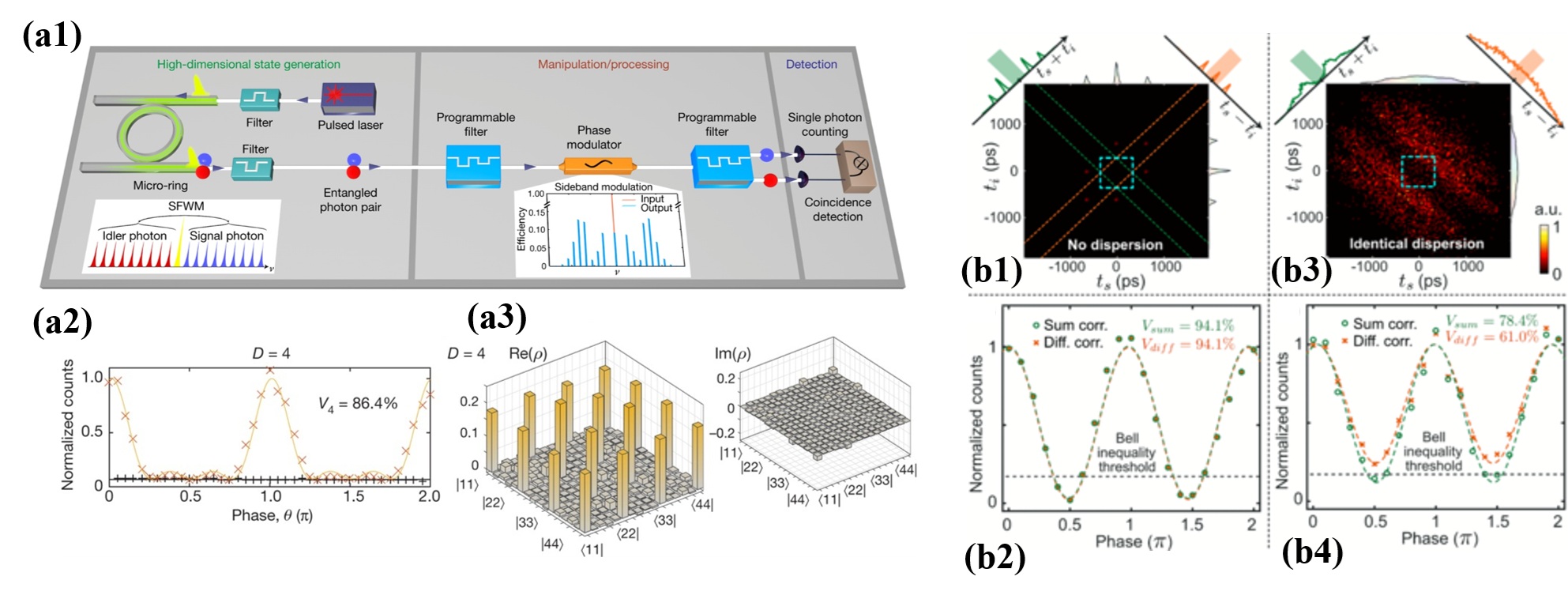
Figure: (a) Generation and control of high-dimensional frequency-domain quantum states. (b) Experimental results for quantum interference of dispersed entangled photon pairs.
To better understand the effect of dispersion on entangled photon pairs, we developed a generalized framework for nonlocal dispersion cancellation leveraging the correlations observed in the sum of arrival times, rather than the usual analysis method based on the difference of arrival times, which we demonstrate as a means for dispersion-resilient quantum communications [3]. In (b), we show experimental results for quantum interference of dispersed entangled photon pairs. (b1) Biphoton time-of-arrival maps of destructive quantum interference without added dispersion. Histograms of the sum ts + ti (green) and difference ts – ti (orange) correlations are shown, with their respective biphoton post-selection regions outlined by green and orange dashed lines. Intersections of these regions with the blue dashed box correspond to applying both single- and biphoton post-selection. (b2) Quantum-interference patterns obtained by retrieving the postselected sum (green circles) and difference (orange crosses) correlations within the blue dashed box, with corresponding fits (dashed curves). (b3) Biphoton time-of-arrival maps of destructive interference after propagation through a total of 200 km of SMF-equivalent dispersion, with sum and difference histograms. (b4) Resulting interference patterns for the post-selected region in both cases. Notice that a violation of Bell’s inequality, with a visibility above 71%, is achieved using the sum correlation approach but not with the conventional difference correlation approach.
[1] C. Rowe, X. Zhu, B. Crockett, G. Lim, M. Goodarzi, M. Fernández, J. van Howe, H. Sun, S. Kaushal, A. Shoeib, and J. Azaña, “Linear optical wave energy redistribution methods for photonic signal processing,” Nature npj Nanophotonics, 2, 13 (2025).
[2] M. Kues, C. Reimer, P. Roztocki, L. Romero Cortés, S. Sciara, B. Wetzel, Y. Zhang, A. Cino, S. T. Chu, B. E. Little, D. J. Moss, L. Caspani, J. Azaña, and Roberto Morandotti, “On-chip generation of high-dimensional entangled quantum states and their coherent control,” Nature, 546, pp. 622–626 (2017).
[3] H. Yu, B. Crockett, N. Montaut, S. Sciara, M. Chemnitz, S. T. Chu, B. E. Little, D. J. Moss, Z. Wang, J. Azaña, and Roberto Morandotti, “Exploiting nonlocal correlations for dispersion-resilient quantum communications,” Physical Review Letters, 134 (22), 220801(2025).
 Recovery of Quantum States from Noise
Noise imposes a major obstacle to the deployment of quantum technologies. In fiber-optic systems, quantum channels often need to travel alongside classical data streams; the resulting noise severely complicates the detection of quantum states. In satellite-based links, stray sunlight similarly buries quantum transmissions, and restricts link up-time.
Recovery of Quantum States from Noise
Noise imposes a major obstacle to the deployment of quantum technologies. In fiber-optic systems, quantum channels often need to travel alongside classical data streams; the resulting noise severely complicates the detection of quantum states. In satellite-based links, stray sunlight similarly buries quantum transmissions, and restricts link up-time.
Detecting quantum photonic signals is difficult: they are inherently weak and cannot be amplified.
Detecting quantum photonic signals is difficult: they are inherently weak and cannot be amplified.
As a result, the only viable approach to overcoming noise involves efficient detectors and noise-reducing elements. Superconducting nanowire single-photon detectors (SNSPDs) have outstanding performance, but many applications still depend on noisier avalanche photodiodes due to their compact size. The standard strategy to reduce noise is to suppress unwanted photons in the temporal, spectral, and/or spatial domains. However, this approach requires precise prior knowledge of the quantum state’s properties; optimal filtering also tends to induce substantial optical loss. An alternative approach is to use the inherent noise-resilience of highly-dimensional entangled states. However, this method brings experimental complication and is not necessarily practical outside of specific use cases. There is thus a pronounced need for a universal denoising method, suitable for both single photons and entangled states, and which performs well even with incomplete information on the time and frequency properties of the input quantum state.
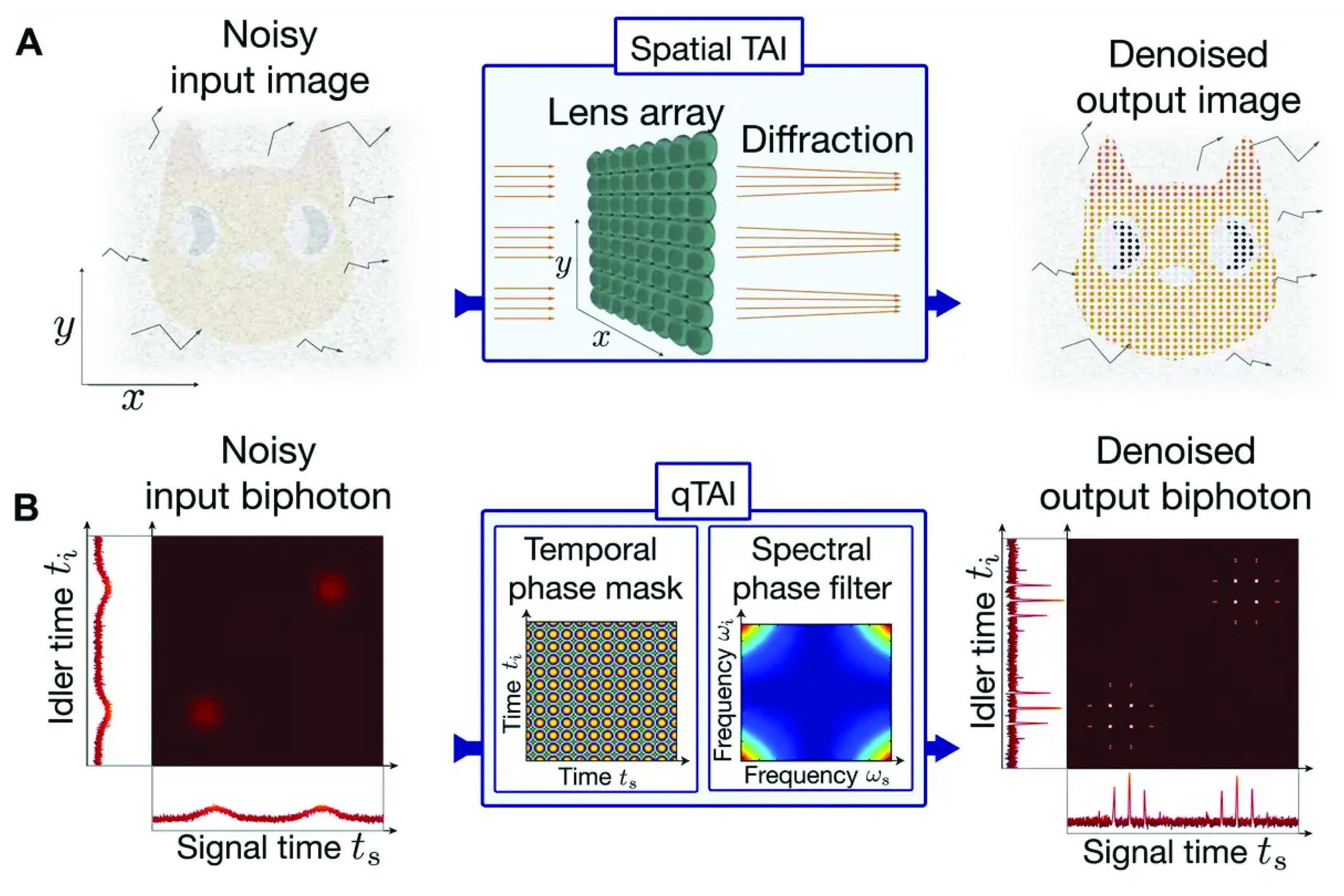
Figure 1: Quantum wave function denoising via the concept of coherent energy redistribution. (A) A TAI, analogous to a lens array, redistributes a spatial image into an array of spots. this device focuses coherent light rays, represented by orange arrows in the image of interest, that are approximately parallel to each other within the extent of a lens. in contrast, the incoherent noise components (gray) point in random directions and are not focused, allowing to discriminate the image of interest from the noise background. (B) Recovery of a deteriorated quantum state using the qTAI here shown in the temporal domain. the joint distribution of the biphotons undergoes two successive (2d) phase manipulations, namely, temporal phase modulation and dispersive propagation, respectively equivalent to a 2d lens array and free-space diffraction processes. the temporal phase mask can conveniently be limited to a phase excursion of 2π on each photon for practical implementation via electro-optic technologies. the excursion of the spectral phase profile can easily extend over hundreds of π through available dispersive elements. this leads to an energy redistribution in the joint distribution, allowing for denoising via postselection on the output peaks.
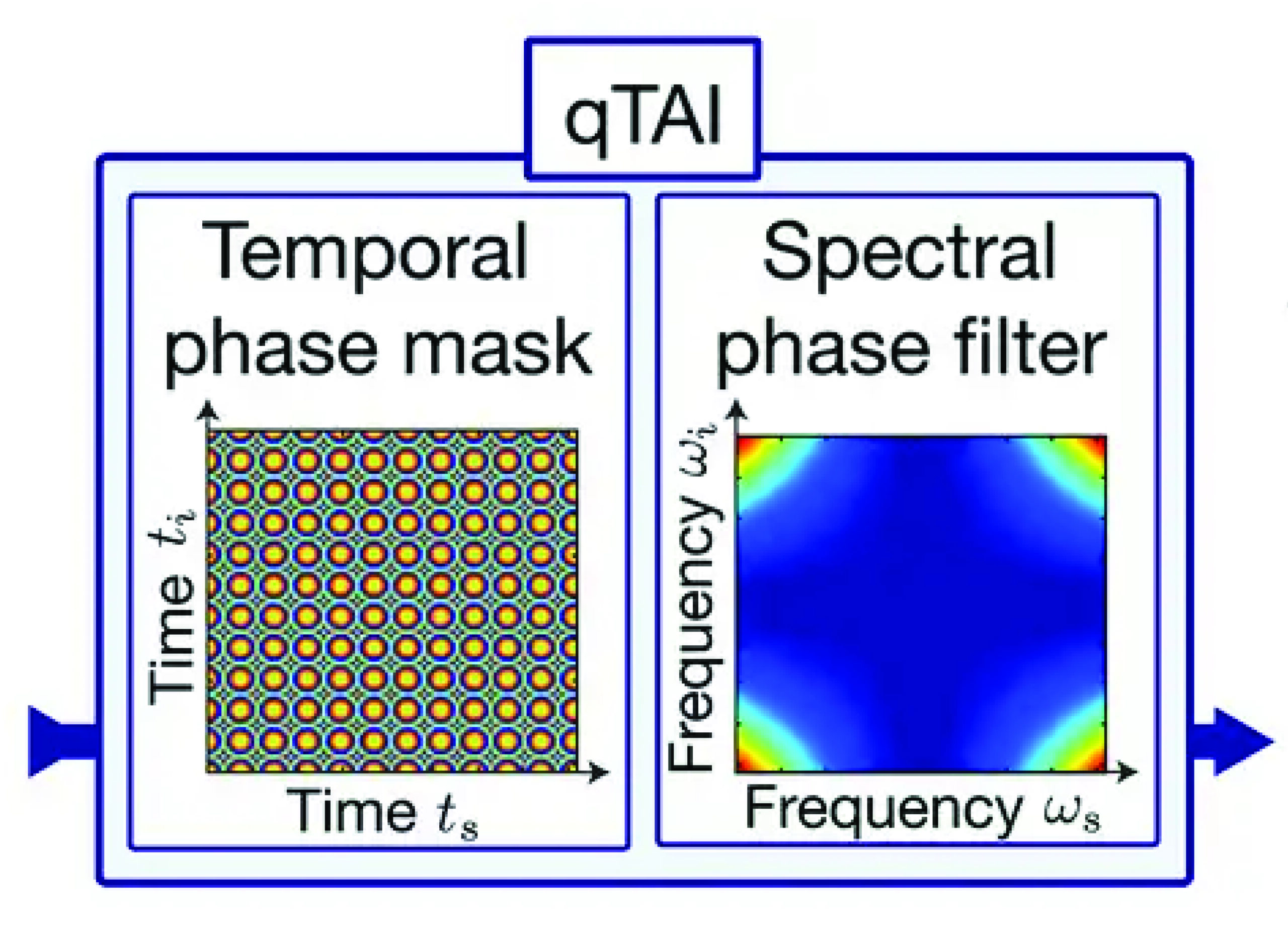
Recently, based on the quantum Talbot array illuminator (qTAI) [1], we have introduced an energy redistribution concept that enhances non-classical correlations between photon pairs. As illustrated in Fig. 1, we showed noise mitigation of correlated biphotons by compressing the coherent part of their two-dimensional (2D) temporal distribution into short peaks that follow the envelope of the original waveform. Due to its lower coherence, the background noise does not focus into these peaks, allowing effective discrimination of the quantum information through postselection. This enables recovering the quantum properties of the deteriorated states which otherwise would be lost, as demonstrated through CAR and interference visibility measurements, shown in Fig. 2. Here, we demonstrated quantum energy redistribution on the temporal representation of optical waves in the near-infrared region, specifically, the telecommunication C-band. However, the principle can also be readily used in the frequency, spatial, or angular momentum representation of waves through manipulations that can be readily found across the electromagnetic spectrum such as microwaves, visible light, or other physical domains like acoustic and plasmonic systems.
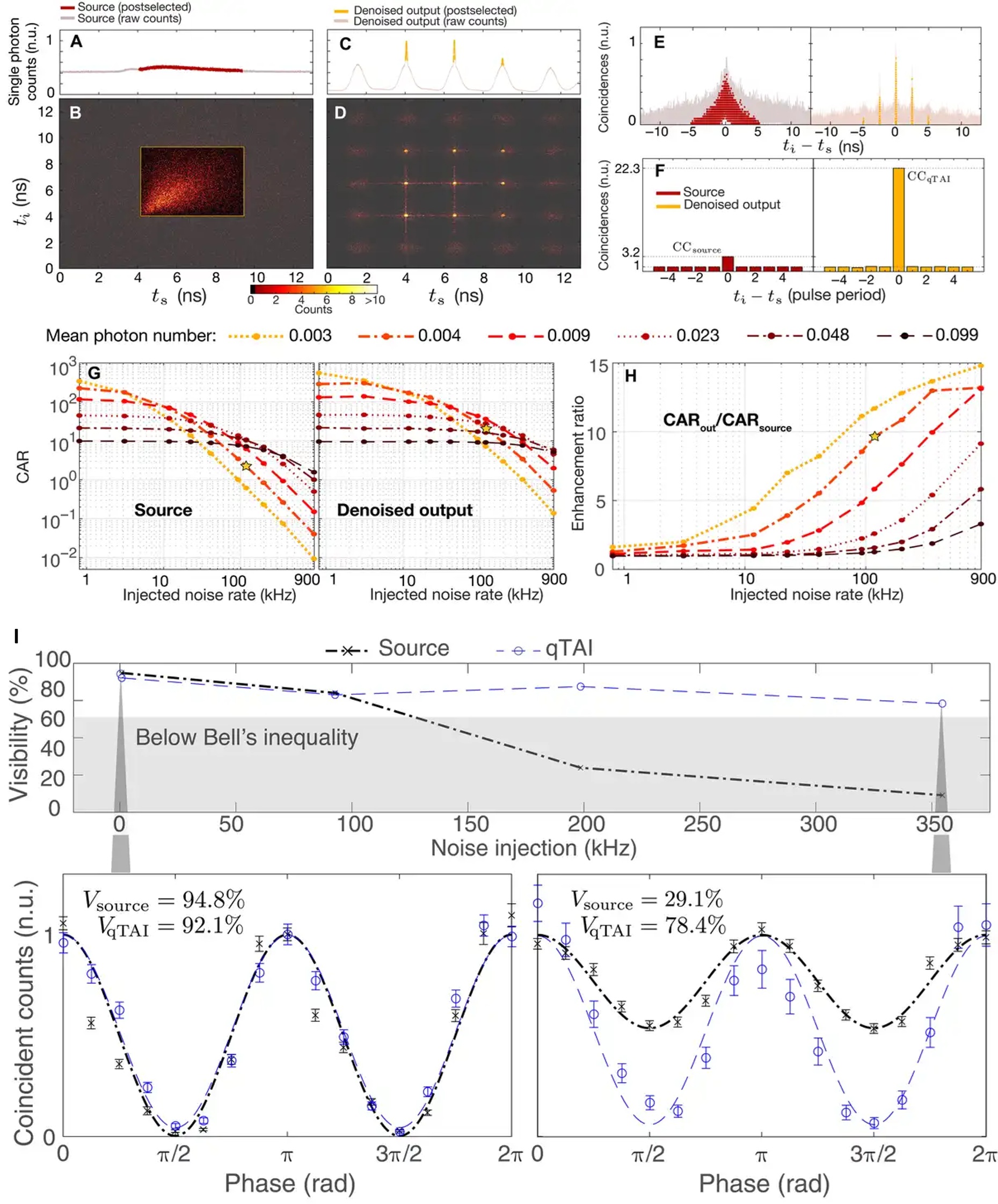
Figure 2: Denoising of biphotons and CAR improvement. (A) histogram of the single counts for the input signal photon. the idler photon follows a similar distribution.(B) Associated biphoton temporal distribution, with the postselection window outlined in yellow. (C and D) same as (A) and (B), but at the output of the denoising module, leading to the expected formation of the tAi peaks. (E) effect of the tAi peak formation on the histograms of the coincidences versus the delay between the photons. (F) histogram of postselected correlated counts versus pulse separation, normalized to their respective accidental counts, displaying a significant improvement in the CAR. (G) CAR of the input and denoised output, as a function of injected noise rate, shown for various mean photon numbers. (H) enhancement of the CAR, expressed as a ratio of the output CAR over the input CAR. The results shown in (A) to (F) correspond to the setting depicted by the yellow star. (I) Quantum interference visibility improvement from the qTAI. The visibility of the input quantum state rapidly falls below the Bell inequality threshold with increasing noise injection, while the entanglement persists when processed by the qtAi module, allowing for an increase in visibility by up to 49.3%. The insets show the quantum interference curves for the source and output of the qtAi module at different noise injection rates.
 Ultra-compact Silicon Photonics Highly Dispersive Elements for Optical Signal Processing
On-chip optical group-velocity dispersion (GVD) is highly desired for a wide range of signal processing applications, including low-latency and low-power-consumption dispersion compensation of telecommunication data signals. However, present technologies, such as linearly chirped waveguide Bragg gratings (LCWBGs), employ spectral phase accumulation along the frequency spectrum. To achieve the needed specifications in most applications, this strategy requires device lengths that are not compatible with on-chip integration while incurring in relatively long processing latencies.
Ultra-compact Silicon Photonics Highly Dispersive Elements for Optical Signal Processing
On-chip optical group-velocity dispersion (GVD) is highly desired for a wide range of signal processing applications, including low-latency and low-power-consumption dispersion compensation of telecommunication data signals. However, present technologies, such as linearly chirped waveguide Bragg gratings (LCWBGs), employ spectral phase accumulation along the frequency spectrum. To achieve the needed specifications in most applications, this strategy requires device lengths that are not compatible with on-chip integration while incurring in relatively long processing latencies.
Here, we demonstrate a novel design strategy that utilizes a discretized and bounded spectral phase filtering process to emulate the continuous spectral phase variation of a target GVD line. This leads to a significant reduction of the resulting device length, enabling on-chip integration and ultra-low latencies. In experiments, we show GVD compensation of both NRZ and PAM4 data signals with baud rates up to 24 GBd over a 31.12 km fiber-optic link using a 4.1 mm WBG-based on-chip phase filter in a silicon-on-insulator (SOI) platform, at least 5× shorter compared to an equivalent LCWBG, reducing the processing latency down to ~100 ps. The bandwidth of the mm-long device can be further extended to the THz range by employing a simple and highly efficient phase-only sampling of the grating profile. The proposed solution provides a promising route toward a true on-chip realization of a host of GVD-based all-optical analog signal processing functionalities.

Figure: (a) Schematic of the on-chip layout utilized for coupling light in and out of the WBG-based phase filter. The zoomed-in view shows the SEM image of one of the fabricated WBGs. The cross-sectional schematic of the fully-etched silicon waveguide on top of the buried oxide is also shown; H and W are the waveguide height and width, respectively. ΔW is the corrugation width. Λ is the nominal grating period. Subwavelength grating-based grating couplers (GCs) couple the fundamental transverse-electric (TE)-like mode into the SOI chip with a device layer thickness of 220 nm. A Y-splitter collects the reflected signal from the WBG. A 20 μm linear adiabatic taper connects the input single-mode waveguide (W = 0.5 μm) with the 2 μm wide multimode waveguide, thus ensuring fundamental-mode operation inside the WBG. The transmitted signal from the WBG is terminated using a taper. (b) Target reflectivity (left) and the spectral phase profile (right) of the discrete phase filter with νr = 10 GHz, superimposed with the spectrum of the input 24 Gb/s NRZ-OOK 215 – 1 PRBS signal (red). (c) Coupling coefficient (κ) profile: magnitude |κ(z)| on the left and phase φκ(z) on the right. (d) Variation of φAP along the WBG’s length. Inset shows a zoom of the sinusoidal variation. (e) Measured reflectivity of the WBG (top) and spectral phase response along the filter’s passband (bottom), centred at ~ 1552 nm. The dashed trace shows the simulated response.
 Sub-THz Optical Frequency Combs from a 250-MHz Mode-Locked Laser
Optical frequency combs (OFCs) with widely spaced spectral lines are highly desirable for applications such as optical communications, microwave photonics, and astronomical spectrograph calibration. However, generating combs with frequency spacings beyond tens of GHz remains challenging, particularly when using conventional low-repetition-rate mode-locked lasers.
Sub-THz Optical Frequency Combs from a 250-MHz Mode-Locked Laser
Optical frequency combs (OFCs) with widely spaced spectral lines are highly desirable for applications such as optical communications, microwave photonics, and astronomical spectrograph calibration. However, generating combs with frequency spacings beyond tens of GHz remains challenging, particularly when using conventional low-repetition-rate mode-locked lasers.
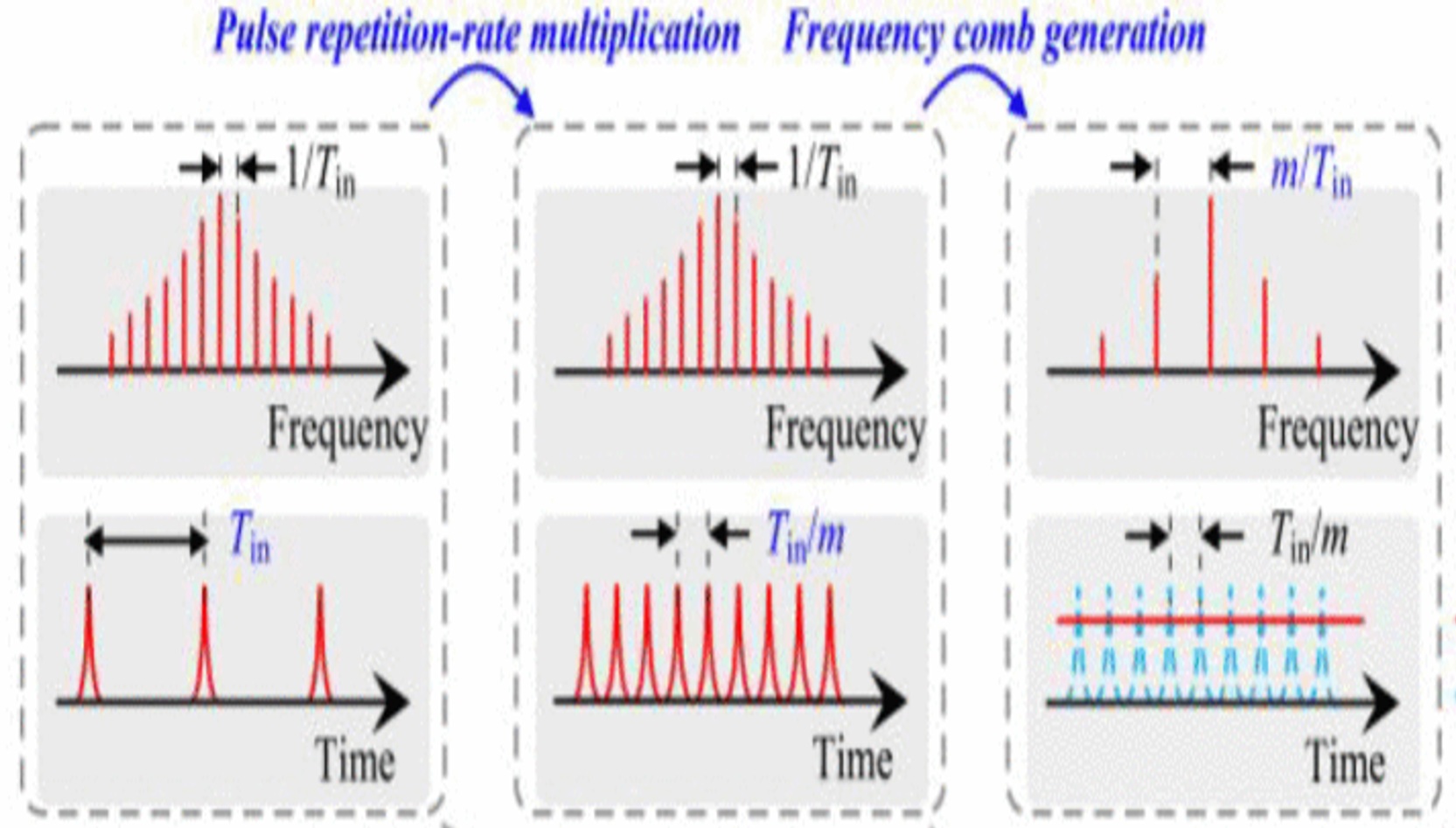
We have demonstrated an efficient, all-fiber approach for generating sub-terahertz OFCs from a commercial 250-MHz mode-locked laser. Our scheme exploits the fractional Talbot effect to multiply the pulse repetition rate through dispersion-induced temporal self-imaging, while fundamentally preserving the optical pulse-train energy. The multiplied pulses are subsequently used to induce cross-phase modulation of a continuous-wave laser in a highly nonlinear fiber, producing an OFC with a line spacing equal to the multiplied pulse repetition rate.
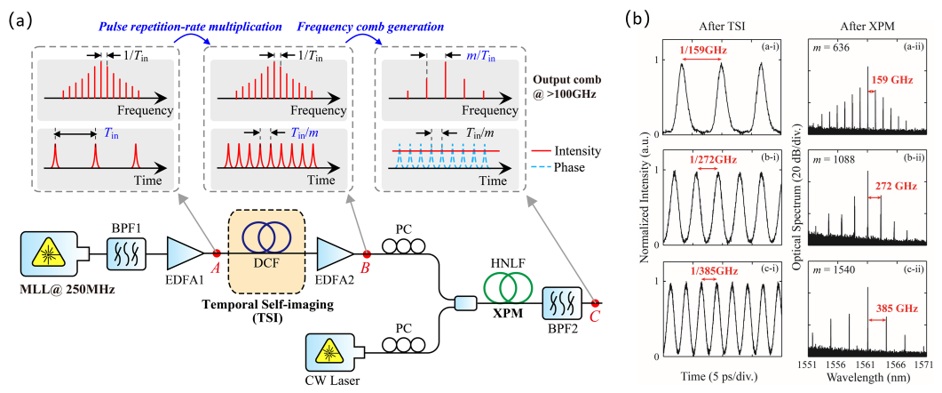
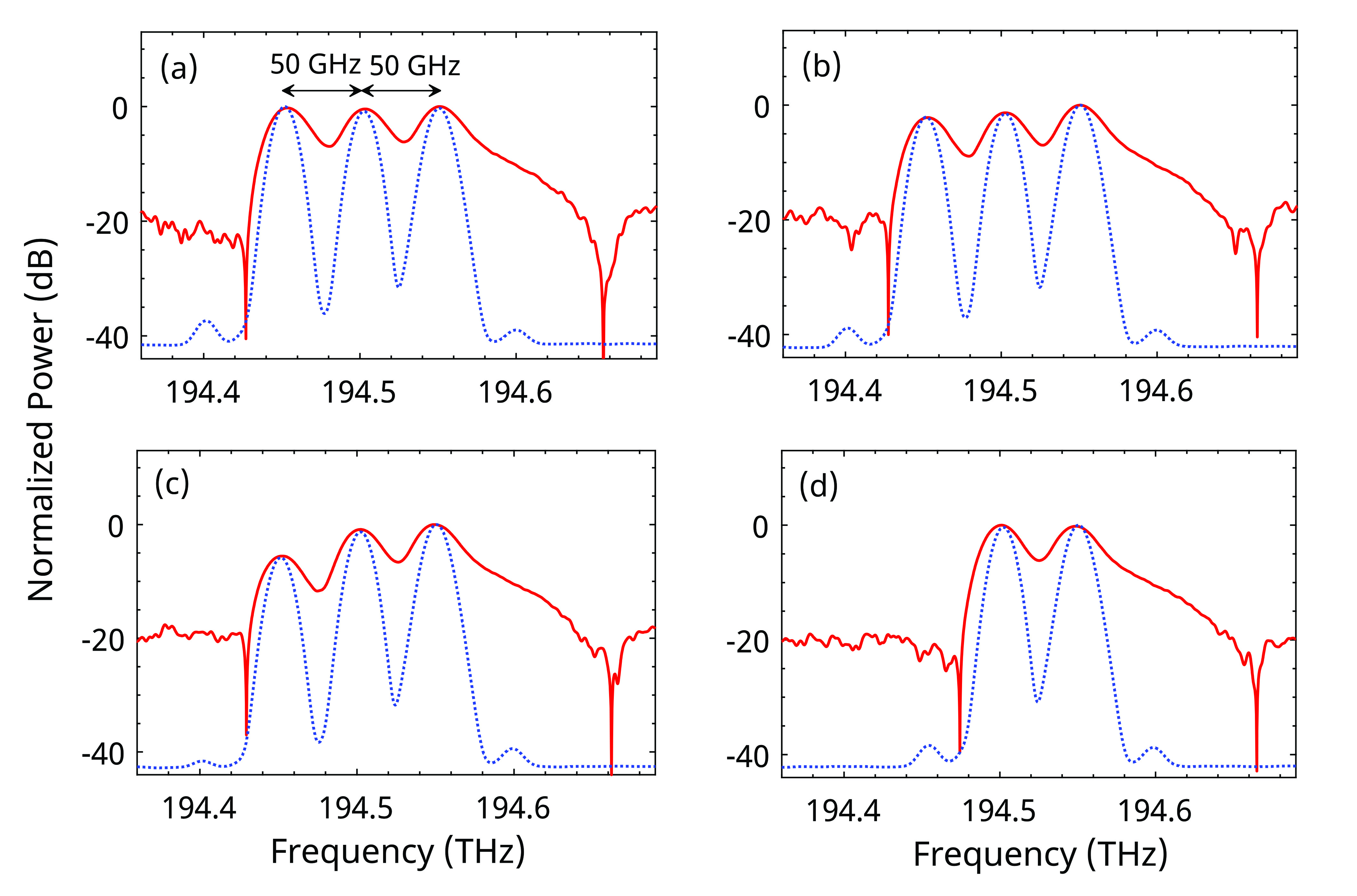
Figure: Sub-THz optical frequency comb generation by efficient repetition-rate multiplication. (a) Operating principle and all-fiber experimental setup: dispersion-induced temporal self-imaging multiplies the 250-MHz laser pulse rate, while cross-phase modulation transfers the multiplied repetition rate to the spacing of a new optical comb. (b) Measured multiplied pulse trains and optical comb spectra for multiplication factors of 636, 1088, and 1540, corresponding to comb spacings of 159, 272, and 385 GHz, respectively. Figures adapted from Figs. 1 and 5 of [1].
Experimentally, we have achieved record-high repetition-rate multiplication factors of up to 1540, enabling OFC generation with frequency spacings as large as 385 GHz. Numerical investigations further reveal the influence of residual dispersion and pump power on the quality of the generated combs. By eliminating the need for high-speed electronics and offering flexibility in comb spacing and central wavelength, our approach provides a promising route toward practical, widely spaced OFC sources for advanced photonic applications.
 Nonlinear Time-Lenses for Ultrafast Optical Signal Processing
Temporal imaging, inspired by the mathematical analogy between diffraction of a beam in space and dispersion of a pulse in time, makes it possible to perform familiar optical operations, such as focusing and Fourier transformation, directly on temporal signals. These techniques offer powerful capabilities for generating, manipulating, and measuring ultrafast optical waveforms, often beyond the reach of conventional instrumentation.
Nonlinear Time-Lenses for Ultrafast Optical Signal Processing
Temporal imaging, inspired by the mathematical analogy between diffraction of a beam in space and dispersion of a pulse in time, makes it possible to perform familiar optical operations, such as focusing and Fourier transformation, directly on temporal signals. These techniques offer powerful capabilities for generating, manipulating, and measuring ultrafast optical waveforms, often beyond the reach of conventional instrumentation.
A key component of this analogy is the “time-lens”, the temporal counterpart of a spatial lens, which operates by imposing a quadratic phase modulation on an optical signal. Although time-lenses can be implemented using electro-optic phase modulators, their performance is ultimately limited by the speed of the driving electronics. Luckily, nonlinear optical effects provide a powerful all-optical alternative that enables processing signals with bandwidths of several terahertz.
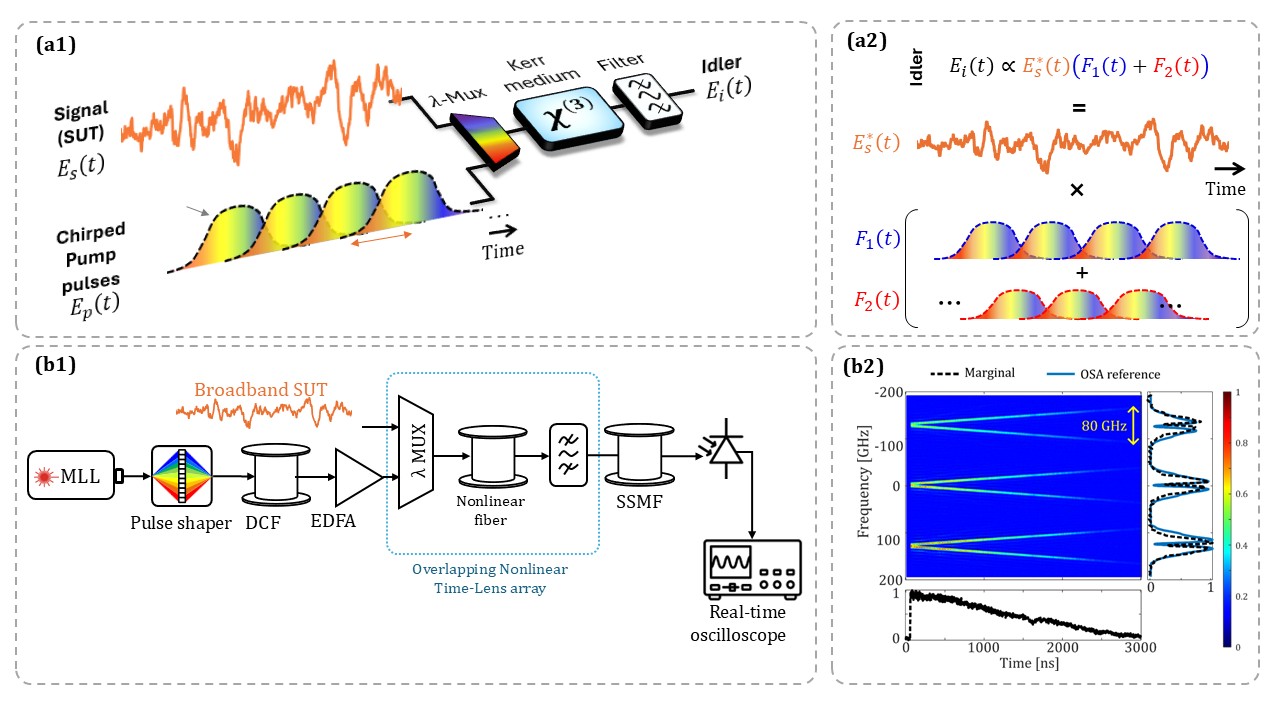
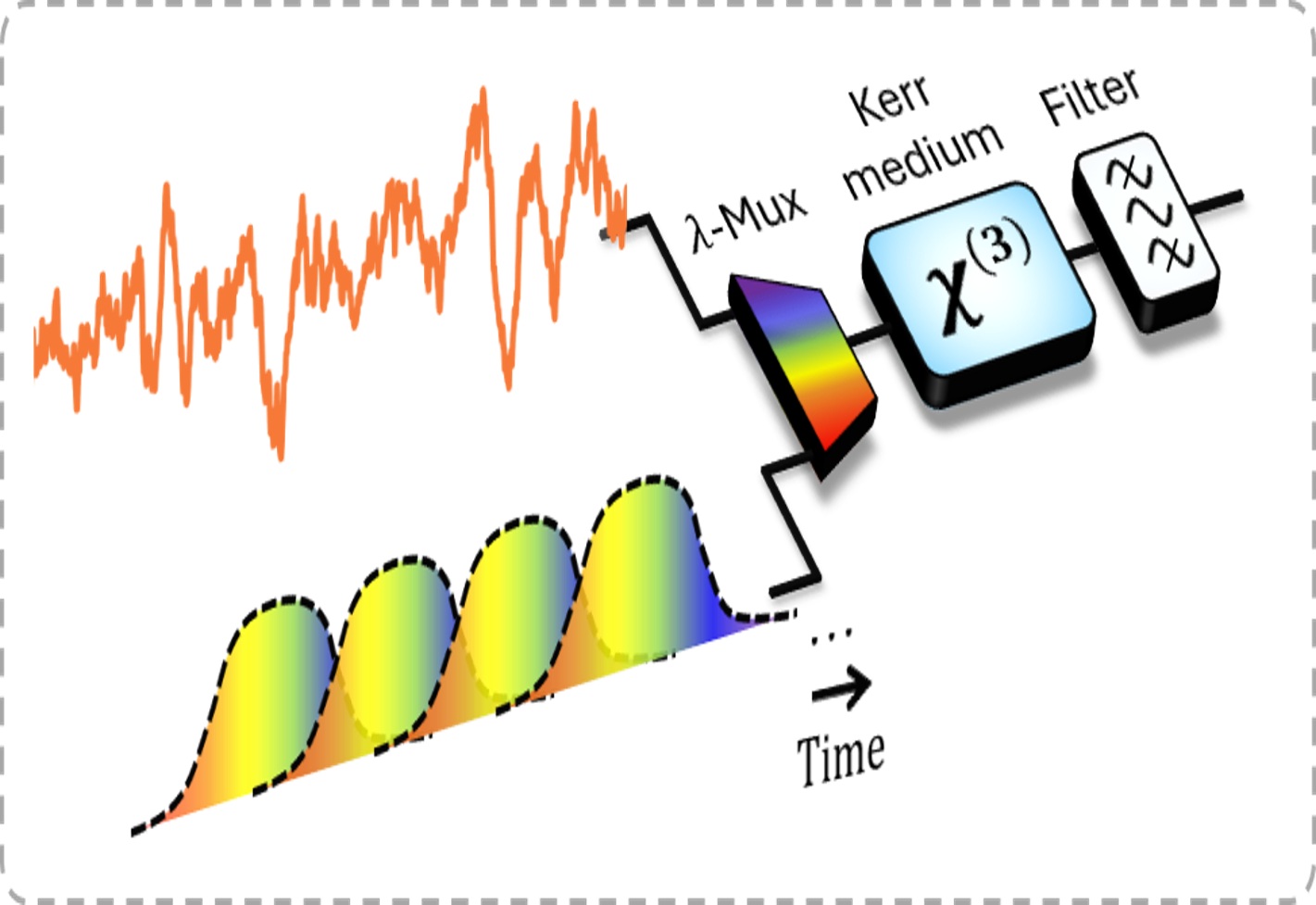
Figure: Gap-free ultrafast spectral analysis using nonlinear overlapping time-lens arrays. (a) Principle of operation. (a1) A signal under test (SUT) interacts with a train of overlapping, linearly chirped pump pulses in a Kerr nonlinear medium, generating an idler through four-wave mixing (FWM). (a2) The generated idler can be described as the product of the phase-conjugated SUT and two interleaved time-lens arrays. These arise from the combined contributions of degenerate and non-degenerate FWM, with the latter exploiting the nonlinear interference between adjacent pump pulses to create additional time lenses. (b) Application to continuous, real-time optical spectral analysis. Following the nonlinear time-lens array, the idler propagates through a dispersive medium satisfying the temporal Fourier-transform condition, mapping its spectral content into the time domain. (b1) Experimental setup. (b2) Experimentally retrieved, gap-free spectrogram of a broadband optical signal, demonstrating continuous spectral analysis over a 400-GHz bandwidth. The color gradient in the pulses illustrates the linear variation of instantaneous frequency (chirp) across each pulse, corresponding to the quadratic temporal phase characteristic of a time lens. MLL: mode-locked laser; DCF: dispersion-compensating fiber; EDFA: erbium-doped fiber amplifier; SSMF: standard single-mode fiber.
Our work explores different approaches to implementing ultrafast time-lenses and related temporal phase structures using nonlinear effects in optical fibers, particularly cross-phase modulation (XPM) and four-wave mixing (FWM) in a Kerr medium. These approaches rely on the interaction between the signal of interest and a suitably designed optical pump. For instance, we demonstrated an XPM-based temporal Talbot array illuminator, which uses a discrete multi-level phase modulation to concentrate the energy of an optical signal into a sequence of short pulses, enabling noise-mitigating passive amplification of broadband waveforms, with experimentally demonstrated amplification factors of up to 20 [1]. We subsequently extend this concept using FWM-based parametric sampling combined with lossless optical decimation, demonstrating decimation factors exceeding 750 and the recovery of weak optical signals buried in a much stronger noise background [2]. Additionally, we have addressed a major challenge in nonlinear time-lens arrays: achieving uninterrupted signal coverage. Conventional FWM-based implementations avoid overlapping pump pulses, leaving temporal gaps in which portions of the incoming signal are not processed. To solve this, we introduced a different approach that deliberately exploits the nonlinear interference between overlapping pump pulses to generate an additional time-lens. This allows continuous, gap-free operation without sacrificing temporal resolution or processing speed [3]. Together, these developments illustrate the potential of nonlinear optics for high-speed signal processing, from noise mitigation and optical amplification to continuous ultrafast spectral measurement.
[1] M. P. Fernández, S. Kaushal, B. Crockett, L. A. Bulus-Rossini, P. A. Costanzo-Caso, and J. Azaña, “An ultra-fast temporal Talbot array illuminator,” Journal of Lightwave Technology, 41 (14), pp. 4725-4733 (2023).
[2] M. P. Fernandez, S. Kaushal, B. Crockett, L. A. Bulus-Rossini, P. A. Costanzo-Caso, and J. Azaña, “All-optical parametric-assisted oversampling and decimation for signal denoising amplification,” Laser & Photonics Reviews, 17, 2200711 (2023).
[3] M. P. Fernández, B. Crockett, C. Rowe, L. A. Bulus-Rossini, P. A. Costanzo-Caso, and J. Azaña, “Real-time all-optical overlapping time-lens array through nonlinear interference,” Optica, 13 (1), pp. 109-118 (2026)
 Real-Time Fourier Transformation with kHz Resolution
Real-time Fourier transformation (RTFT) enables Fourier analysis at speeds beyond conventional digital signal processing. Optical RTFT commonly relies on mapping the spectrum of the waveform under test to the time domain by inducing large amounts of group velocity dispersion (see for instance pioneering work in IEEE J. Quantum Electron. 36, pp. 517-526 (2000)). However, the relatively limited dispersion of commonly-available transparent media limits the typical optical frequency resolution of RTFT to above the GHz range.
Real-Time Fourier Transformation with kHz Resolution
Real-time Fourier transformation (RTFT) enables Fourier analysis at speeds beyond conventional digital signal processing. Optical RTFT commonly relies on mapping the spectrum of the waveform under test to the time domain by inducing large amounts of group velocity dispersion (see for instance pioneering work in IEEE J. Quantum Electron. 36, pp. 517-526 (2000)). However, the relatively limited dispersion of commonly-available transparent media limits the typical optical frequency resolution of RTFT to above the GHz range.
This represents a critical limitation for applications in real-time spectroscopy, ultrafast detection, imaging and sensing, as well as photonic-assisted generation and processing of radio-frequency (RF) signals. We have recently proposed an RTFT concept that extends the resolution of RTFT analysis to the kHz regime, by avoiding the use of dispersion altogether. The concept is based on the superposition of multiple input signal replicas, which shift simultaneously along the time and frequency domains in a frequency-shifted feedback (FSF) loop.
Under the scheme depicted in Fig. (a), an input signal photon circulates in the FSF loop with a round-trip time τc. On each round trip, an acousto-optical frequency shifter (AOFS) shifts the photon’s frequency by fs. An intra-cavity bandpass filter and amplifier controls the number of round trips in the loop. Assuming that the product of the round-trip time and frequency shift equals an integer (p = 1, 2, 3, …), the shape of the output time trace reproduces the optical spectrum profile of the input. The inverse of a photon’s total lifetime in the loop gives the technique’s frequency resolution. Fig. (b) shows the obtained RTFT time traces of a continuous-wave laser modulated with a single radio-frequency tone of frequency fm. Fig. (c) compares the input spectrum under analysis with the obtained time trace (fm = 200 kHz).
We have demonstrated successful RTFT of optical signals with a frequency resolution as high as about 30 kHz, and a time-bandwidth product higher than 400 – results that exceed dispersion-based schemes by orders of magnitude. The processing architecture features minimal latency (equal to the inverse of the frequency resolution) and, contrary to other schemes, the method requires neither truncated nor coherent input light. This concept opens new perspectives in optical real-time Fourier analysis, with applications beyond our optical-domain implementation.

Figure: (a) Sketch of a generic FSF cavity. The AOFS is driven at frequency fs = ωs /2π, resulting in a frequency shift per round trip equal to fs. The cavity round-trip time is τc = 1 / fc = 2π/ωc. (b) Output time traces recorded for an input laser phase modulated by a sine wave at different frequencies (50, 450, and 1050 kHz). No averaging is performed. (c) Top: optical spectra of the input laser after PM format, reconstructed from heterodyne beatings with the seed laser (linear scale). The zero-frequency line is added manually. The PM function is sine wave at frequency of 200 kHz. Bottom: time trace recorded at the output of the FSF loop seeded by the corresponding signal (16 traces averaged). The time axis in the bottom plot has been scaled in relation to the frequency axis of the upper plot, according to the FTM scaling law.
 Real-Time Spectrum Monitoring of Optical Networks
Monitoring the health and performance of fiber-optic networks at the physical-layer level typically involves tracking the frequency spectrum of data signals across different wavelength-division-multiplexed (WDM) channels. The main goal is to identify the WDM channels present at any given time across the frequency band of interest and determine their relative intensity.
Real-Time Spectrum Monitoring of Optical Networks
Monitoring the health and performance of fiber-optic networks at the physical-layer level typically involves tracking the frequency spectrum of data signals across different wavelength-division-multiplexed (WDM) channels. The main goal is to identify the WDM channels present at any given time across the frequency band of interest and determine their relative intensity.
Several optical spectrum monitoring schemes, mainly based on conventional optical spectrum analyzers (OSAs), have been proposed and developed over the years. However, these methods suffer from slow measurement update rates, typically in the kHz range or slower. In addition, these methods are generally costly and often rely on bulky designs, such as those using free-space optics, which may be difficult to integrate and can pose challenges for in-line monitoring along optical fiber links.
Previously, we proposed and demonstrated a real-time optical monitoring (RTOM) system and method based on simple and practical linear fiber-optic components that use dispersive frequency-to-time mapping (D-FTM) to monitor dense-wavelength-division-multiplexed (DWDM) signals in fiber-optic telecommunication links. A D-FTM directly maps the spectrum of a given signal into the time domain using linear group-velocity dispersion (GVD), provided that the temporal far-field condition is satisfied. The system periodically selects a short section of the continuous telecommunication data signal using electro-optic (EO) modulation. The RTOM method continuously maps the spectral content of DWDM data streams into the time domain, allowing it to determine the presence and relative power of individual channels with high frequency resolution (~30 GHz), high sensitivity (~1 dB), and fast measurement update rates (in the MHz range).
Our research demonstrates the RTOM system’s versatility under diverse operating conditions, including different modulation formats (amplitude and coherent data signals), modulation strategies (MZM and DML), transmission rates ranging from 1 Gb/s to 420 Gb/s, and channel spacings from 50 GHz to 100 GHz. While the proposed scheme is implemented using fiber-optic technology, it has potential for realization on an integrated-waveguide platform, supporting practical deployment in real-world optical telecommunication systems. Looking ahead, the RTOM technique holds significant promise for enabling effective spectrum monitoring and management in next-generation, high-capacity, and dynamic optical networks, contributing to more efficient, reliable, and agile communication infrastructures. Moreover, the demonstrated system may be of interest for other scientific and engineering applications, including next-generation optical sensor monitoring, autonomous vehicles, and medical imaging.
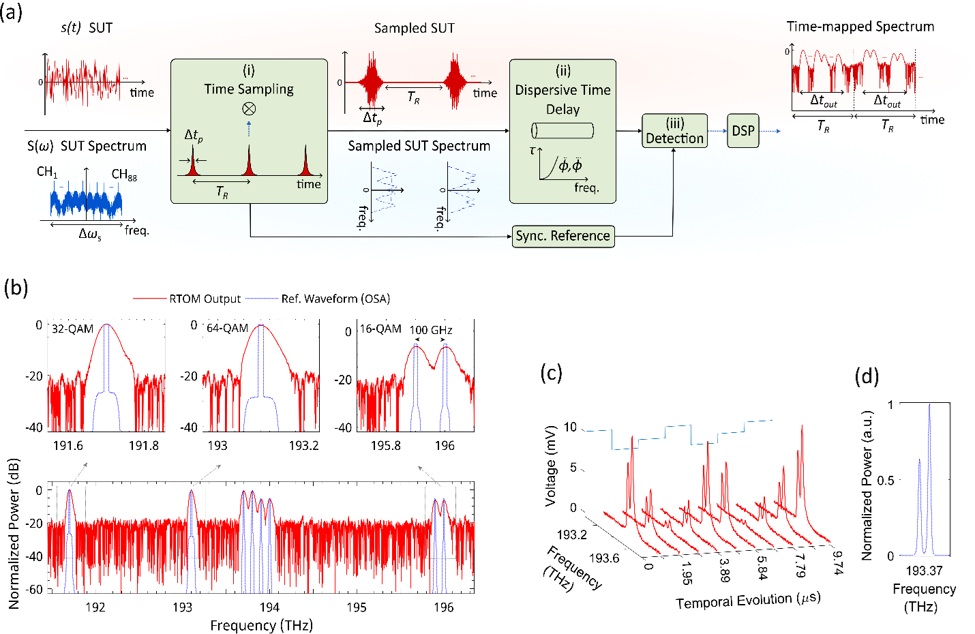
Figure: (a) Schematic of the proposed design for RTOM system and method. Design is composed of three main units: (i) a periodic time sampling unit, (ii) a dispersive unit, and (iii) a high-speed photodetection and acquisition device. In the example provided, the signal under test (SUT) is a WDM stream of NRZ-OOK data signal, including both upstream and downstream signals, and covering the full C-band, i.e., 88 channels, with a channel spacing of ~50 GHz. The output time-mapped spectrum corresponds to each analyzed sample of the SUT, covering a temporal duration Δtout. (b) Simulation result: RTOM trace obtained for the first sample of the SUT using a combination of coherent modulation formats: 16-QAM, 32-QAM, and 64 QAM, with bit rates of 100 Gb/s, 300 Gb/s, and 420 Gb/s, respectively. The dispersion amount is set to φ̈ = 795.77 ps2/ rad. The SUT spans the full C band with a channel spacing of 100 GHz. (c) Experimental result: Output waveform obtained for the dynamic SUT changing every few samples, with 50 GHz channel spacing at a bit rate of 10 Gb/s. The blue waveform shows the intensity variation of the SUT. (d) Experimental result: Waveform obtained from a conventional OSA for all samples.
[1] A. Shoeib, M. P. Fernández, C. Rowe, R. Maram, P. Ricciardi, and J. Azaña, “Real-time spectrum monitoring system for next-generation high-capacity optical networks,” Journal of Lightwave Technology, 43 (14), pp. 6469-6483 (2025).
[2] A. Shoeib, M. P. Fernández, C. Rowe, R. Maram, P. Ricciardi, and J. Azaña, “Fiber-optic spectrum monitoring of wavelength-division-multiplexed telecommunication signals with MHz update rates,” Optics Letters, 49 (5), pp. 1245-1248 (2024).
 Full-field Broadband Invisibility Through Reversible Wave Frequency-Spectrum Control
The last decade has seen the emergence of numerous methods to conceal objects by preventing light from interacting with them. This is known as invisibility cloaking, and solutions have been demonstrated over different regions of the electromagnetic spectrum, and even for waves of very different nature, including acoustic and thermal waves. While effective invisibility solutions have been demonstrated for single-frequency illumination, realistic operation conditions require cloaks capable of concealing objects from broadband illumination.
Full-field Broadband Invisibility Through Reversible Wave Frequency-Spectrum Control
The last decade has seen the emergence of numerous methods to conceal objects by preventing light from interacting with them. This is known as invisibility cloaking, and solutions have been demonstrated over different regions of the electromagnetic spectrum, and even for waves of very different nature, including acoustic and thermal waves. While effective invisibility solutions have been demonstrated for single-frequency illumination, realistic operation conditions require cloaks capable of concealing objects from broadband illumination.
An ideal cloak must restore the exact amplitude and phase distributions of the illumination wave–the full field–at its output. However, current invisibility strategies rely on altering the propagation path of the wave around the object to be concealed. By fundamental operation principle, this approach introduces undesired phase variations among the different frequency components of a broadband illumination wave, thus necessarily distorting the wave’s temporal profile. This way, phase-sensitive or temporal detection renders current invisibility cloaking solutions vulnerable to phase-coherent broadband illumination.
We demonstrated that it is possible to conceal the presence of an object to an observer under broadband illumination by altering the spectrum of the probe wave through reversible transformations of its temporal and spectral phase profiles. This novel approach has been referred to as spectral invisibility cloaking. In particular, the energy spectrum of the illumination wave is first redistributed towards frequency regions where the object to be concealed is transparent, and the wave is subsequently restored to its exact original shape once it has cleared the object. This way, the illumination wave can propagate through the object, entirely unaltered, while avoiding any interaction between object and wave.
Our particular demonstration of this general concept made use of a set of phase transformations derived from the theory of the Talbot effect. First, the spectrum of a coherent broadband wave was redistributed into a periodic set of frequency gaps (regions of the wave’s spectrum stripped of energy) through a combination of group velocity dispersion and electro-optical phase modulation. The frequencies of such gaps were chosen to match the interaction spectrum of the object to be concealed, namely, an optical filter consisting of a periodic set of phase-shifted wide absorption bands, in the reported experiments. The spectrally-redistributed wave propagated then through the filter without interacting with it, and the applied transformations were reversed at the output of the filter, recovering both the spectral and temporal profiles of the original wave. When the cloak transformations were not applied, the action of the filter (its signature) was clearly observed in both the frequency and time domains.
We believe that the spectral invisibility concept, by virtue of preserving the full-field profile of the illumination wave, paves the way towards development of practical broadband invisibility cloaks. This work has attracted much attention worldwide, from news platforms such as Global news (Canada), both online and on the radio (July 5, 2018, time mark 01h:02min), Lapresse (Québec), The Times (UK), El País (Spain), Radio Televisión Española (Spain), ANSA (Italy), Optics and Photonics news (USA), to name a few.

Figure: (a) Process of concealing the signature of an object from detection by a broadband illumination wave through reversible redistribution of the wave’s frequency spectrum.
(b) and (c) show experimental results (frequency spectra and temporal autocorrelation traces, respectively) of a proof-of-concept demonstration of spectral invisibility cloaking of an object (optical filter) illuminated by a short pulse of light: (1) broadband illumination wave, (2) object’s signature when the cloak is inactive, and (3) output of the cloak, showing concealment of the object’s presence. The idea is explained with this concept video, further described by this short experiment video.
 Incoherent Lightwave-based High-Speed Microwave Signal Processing
We proposed a very general concept for user-defined, arbitrary linear processing of incoming high-speed RF (microwave, millimeter-wave) signals through temporal modulation of the signal under analysis by a spectrally-shaped broadband incoherent lightwave followed by optical chromatic dispersion [1]. Such a concept is referred to as “time-spectrum convolution” and it has enabled implementation of many important functionalities on high-speed RF signals.
Incoherent Lightwave-based High-Speed Microwave Signal Processing
We proposed a very general concept for user-defined, arbitrary linear processing of incoming high-speed RF (microwave, millimeter-wave) signals through temporal modulation of the signal under analysis by a spectrally-shaped broadband incoherent lightwave followed by optical chromatic dispersion [1]. Such a concept is referred to as “time-spectrum convolution” and it has enabled implementation of many important functionalities on high-speed RF signals.
As an example, a wide range of time-domain signal processing operations are based on the use of large amounts of group-velocity dispersion (GVD) over time-limited waveforms. Dispersion-engineering has been extensively used in the optical domain for applications such as real-time Fourier transformation (RTFT), real-time reflectometry and interferometry, pulse repetition rate multiplication, temporal imaging etc. Similar concepts have also proved extremely useful in other frequency regions, including the microwave domain. However, in the microwave domain, there is a lack of devices capable of inducing a large amount of GVD, namely above a few ns2, over a wide frequency range (0 ~ 100 GHz). We propose a fiber-optics incoherent-light configuration based on the time-spectrum convolution concept, aimed at inducing extraordinary GVD amounts on electrical (RF) waveforms (double-pulse in the illustration below) [2].
Fig. A shows an schematic of the proposed fiber-optics incoherent-light configuration. This system is capable of fulfilling the above defined stringent GVD-bandwidth requirements. In the illustrated example, a GVD equivalent to that of 185,000 km of standard single-mode fiber (SMF) is induced on the input microwave signal by propagation through a section of only 120 km of SMF. Temporal differentiation and integration of high-speed microwave signals have been also demonstrated by our group based on the same time-spectrum convolution concept.

Figure: (A) Schematic of operation principle for photonic microwave dispersion based on the concept of incoherent time-frequency convolution. (B) Results corresponding to an example of real-time Fourier transformation (linear frequency-to-time mapping) of a nanosecond-long input microwave signal with a full bandwidth approaching 20 GHz. The bottom plot shows the measured output temporal waveform compared with the signal input spectrum.
[1] Y. Park and J. Azaña, “Optical signal processors based on time-spectrum convolution process,” Optics Letters, 35 (6), pp. 796-798 (2010).
[2] Y. Park and J. Azaña, “Ultrahigh dispersion of broadband microwave signals by incoherent photonic processing,” Optics Express, 18 (14), pp. 14752-14761 (2010).
[3] A. Malacarne, R. Ashrafi, M. Li, S. LaRochelle, J. Yao, and J. Azaña, “Single-shot photonic time-intensity integration based on a time-spectrum convolution system,” Optics Letters, 37 (8), pp. 1355-1357 (2012).
Real-time and Single-shot Recovery of Arbitrary Subnoise Signals
The accurate characterization of ultra-short light pulses is essential to a wide range of scientific and technical fields. Considering the intrinsic bandwidth limitations of photo-detection systems, optical pulses with time features in the picosecond regime and faster are often characterized through methods based on frequency spectrum measurements. A complex (amplitude and phase) spectral representation of the waveform is needed to reconstruct the waveform profile along the time domain. Due to the small wavelength of optical waves, coherent detection schemes are overly sensitive to noise and environmental variations, such that generally, robust and reliable complex field detection schemes should operate on a single-shot and real-time fashion.
The problem of noise in pulse characterization is particularly important when dealing with weak-intensity waveforms; active amplification does not offer a solution in this case since this actually worsens the relative noise content along the signal.
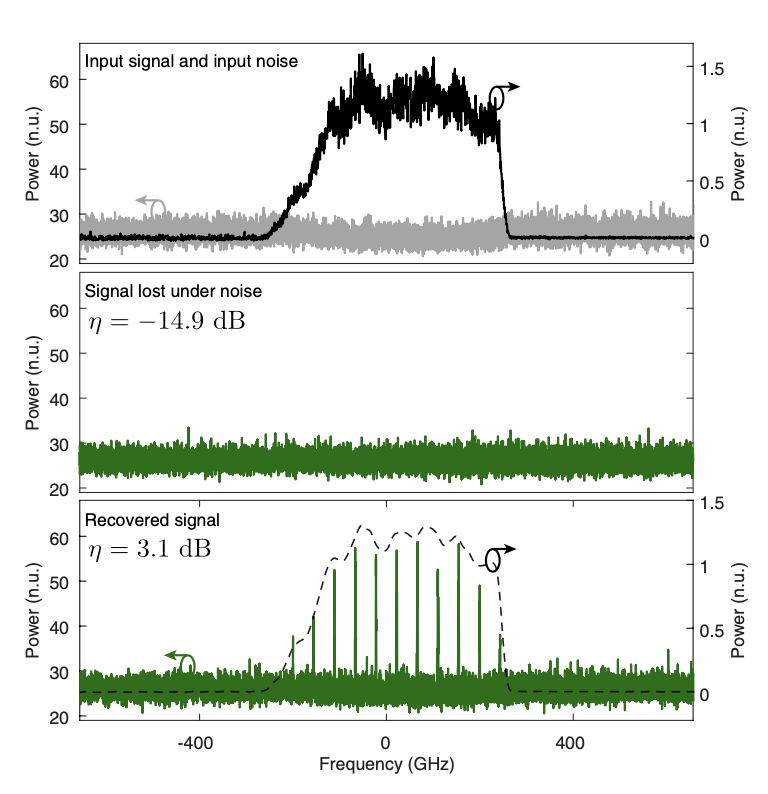
Recently, we have proposed a technique that denoises the waveform of interest, even when the signal is totally buried under noise, regardless of its time of arrival, central frequency, bandwidth, or shape [1]. No a priori knowledge of any of these parameters is needed, as desired for most practical applications. Moreover, the waveform denoising process is implemented directly in the analog physical wave domain, thus avoiding the need for any digital post-processing. Referred to as the spectral Talbot array illuminator (S-TAI), the proposed scheme redistributes the frequency spectrum of the incoming signal into discrete peaks whose envelope follows an amplified copy of the waveform of interest over the stochastic (incoherent) noise background (see Fig. 1(a-b)). This is achieved through a suitable combination of linear wave phase transformations, namely, dispersive propagation and temporal phase modulation. Using standard telecommunication components, we experimentally show the unprecedented capabilities offered by the S-TAI concept through demonstrating real-time and single-shot recovery of broadband optical waveforms that are entirely buried under in-band noise (see Fig. 1(c-g). The principle is based on a combination of linear wave transformations, which are available on virtually all wave systems. This includes both classical and quantum systems over most regions of the electromagnetic spectrum, as well as other physical supports (e.g., acoustics or matter waves), allowing for a wide spread of possible applications.
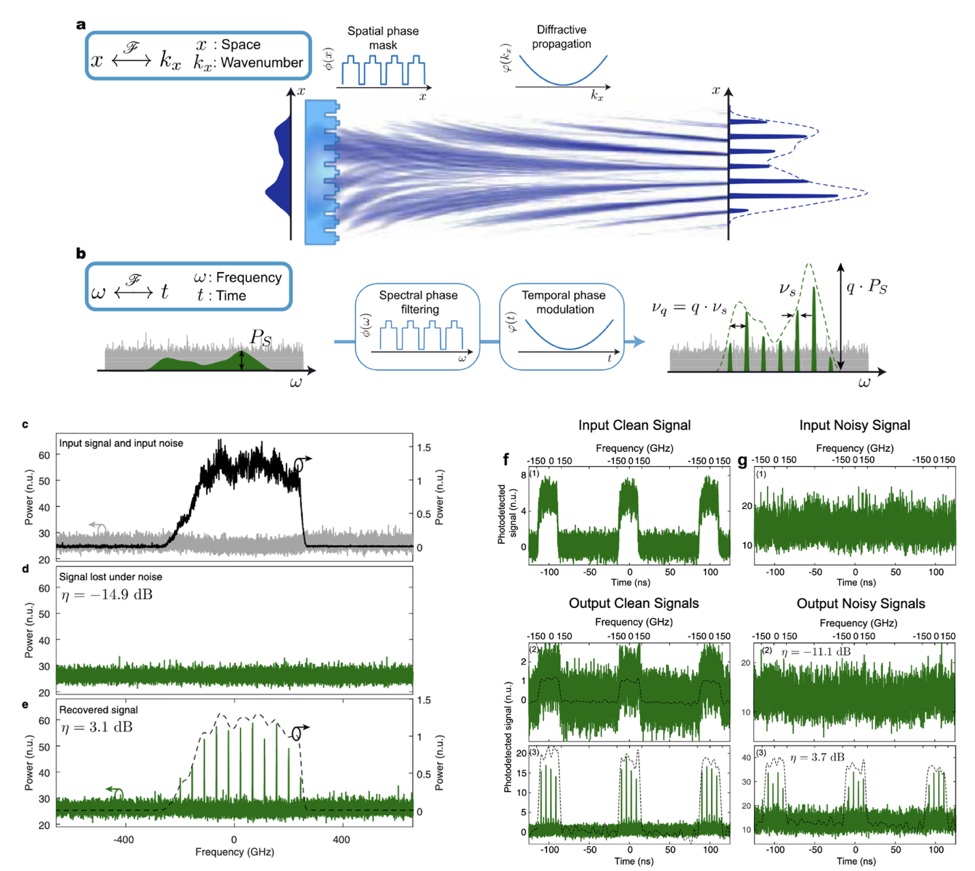
Figure: S-TAI denoising concept. (a) Originally observed in the spatial domain, a Talbot Array Illuminator (TAI) focuses a uniform beam into an array of bright spots. A TAI consists of a discrete phase mask φ(x) applied along the transversal spatial direction x, followed by free-space diffraction, which imposes a continuous quadratic phase φ(kx) along the angular frequency variable kx, the Fourier-conjugate of x. The involved Fourier transformation is indicated by the symbol ℱ. We show here that the well-known TAI mechanism can be applied on a non-uniform spatial wavefront. (b) Through a mathematical analogy between the space and temporal frequency domains, a similar process is implemented along the frequency spectrum representation of a temporal waveform (i.e., S-TAI). In this case, the observation domain is along the radial frequency variable ω, and its Fourier-dual domain is along the time variable, t. Thus, the S-TAI can be constructed by a suitable discrete spectral phase filter φ(ω), followed by a continuous quadratic temporal phase modulation φ(t), as detailed in the main text. This creates a sampled version of the input spectrum, with peaks of width νs separated by νq = qνs, outlining a copy of the waveform of interest amplified by a factor q. On the other hand, the incoherent noise content (here illustrated as a gray background) is left untouched, thus enabling the recovery of a waveform initially buried under noise. (c) Experimental demonstration. A weak optical waveform (black, right axis) is combined with strong stochastic (ASE) noise (gray, left axis). Notice the significant difference in the vertical scales. (d) The waveform is completely buried under noise, becoming undetectable. (e) The waveform of interest is successfully recovered from noise (green, left axis), as indicated by η, a measure of the visibility of the waveform against the noise. The input (dashed black trace, right axis) is shown for comparison, confirming that the envelope of the S-TAI peaks outlines an amplified, high-fidelity copy of the input signal. (f) Real-time recovery of spectral waveforms undergoing an S-TAI process. By using real-time optical Fourier transformation (RT-OFT) via dispersive propagation, the spectra of interest were directly mapped into the time domain, such that they could be detected on the fly using a photodiode connected to a real-time oscilloscope. The measurements are shown in green, and a digitally filtered and scaled version of the SUT spectrum is shown in each case (dashed black) to facilitate a direct comparison with the recovered waveform. All waveforms are normalized to the peak value of the output signal with the phase modulation turned off. (1) A waveform with a relatively high visibility is first generated, and (2) the waveform is attenuated by the insertion loss of the S-TAI processing system, as observed by measuring the waveform at the output of the S-TAI system with the phase modulation off. (3) Activating the phase modulation leads to the formation of spectral peaks, recovering an accurate representation of the initial signal spectrum directly along the time domain (i.e., in real-time). (g) Similarly, when the waveform has a low visibility (buried under noise), RT-OFT of the signal at the output of the S-TAI is also able to recover the information of the initial waveform, in a real-time and single-shot fashion.
 Time-Frequency Processing
User-defined manipulation of the temporal evolution of an electromagnetic (EM) wave’s frequency components, the so-called time-frequency (TF) distribution, in a versatile and real-time fashion remains very challenging in many modern and emerging applications, including next-generation telecommunication systems and intelligent remote sensing platforms (Radar and Lidar). The key feature is that these dedicated filtering operations in the applications need to be reconfigured at a very high speed, in a nanosecond scale or even faster, while offering a set of specifications commensurate with the target performance, including operation over broad frequency bandwidths, e.g., over tens of GHz, and low latency (ns-scale).
Time-Frequency Processing
User-defined manipulation of the temporal evolution of an electromagnetic (EM) wave’s frequency components, the so-called time-frequency (TF) distribution, in a versatile and real-time fashion remains very challenging in many modern and emerging applications, including next-generation telecommunication systems and intelligent remote sensing platforms (Radar and Lidar). The key feature is that these dedicated filtering operations in the applications need to be reconfigured at a very high speed, in a nanosecond scale or even faster, while offering a set of specifications commensurate with the target performance, including operation over broad frequency bandwidths, e.g., over tens of GHz, and low latency (ns-scale).
We have recently proposed a concept for user-defined real-time manipulation of the joint TF distribution of EM waves directly in the analogue domain, ideally suited for operation on high-speed waves. The proposed approach combines the versatility of the DSP approach with the performance (e.g., processing speed and bandwidth) of a photonic solution. As illustrated in Fig. 1(d), our strategy involves mapping the TF distribution (the STFT) of the incoming wave along the time domain, which in turns enables a user-defined manipulation of the wave’s TF distribution through temporal modulation techniques. Since the time-mapped STFT is achieved using two consecutive phase transformations (along the temporal and spectral domains, respectively), the processed wave can be recovered by simply applying the opposite phase manipulations.

Figure. (a) Schematic diagram of the proposed joint time-frequency filtering concept. (b) Demonstration of broadband joint time-frequency (TF) filtering with nanosecond resolution.
We experimentally demonstrated the use of this concept for realization of important functionalities beyond the potential of present technologies, an arbitrary manipulation of the joint TF distribution of the input microwave signal over a full bandwidth up to 92 GHz, with rapid tuning speeds, in the nanosecond range, and with a fine frequency resolution, down to a few hundreds of MHz, and the direct synthesis of high-speed waves with user-defined sophisticated TF distributions.
 On-Chip Dynamic RF Frequency Measurement
Dynamic identification of instantaneous microwave or mm-wave frequencies is a critical functionality in widespread applications such as broadband communications, biomedical instrumentation, electronic countermeasures, radar and more. Photonics solutions have demonstrated the potential to overcome the lack of flexibility and severe bandwidth limitations of current electronic instantaneous frequency measurement (IFM) systems.
On-Chip Dynamic RF Frequency Measurement
Dynamic identification of instantaneous microwave or mm-wave frequencies is a critical functionality in widespread applications such as broadband communications, biomedical instrumentation, electronic countermeasures, radar and more. Photonics solutions have demonstrated the potential to overcome the lack of flexibility and severe bandwidth limitations of current electronic instantaneous frequency measurement (IFM) systems.
However, they suffer from at least one of the following critical problems: they are either implemented using costly, bulky discrete components, and/or they are based on nonlinear-optics processes, requiring high optical powers for operation. These limitations represent a fundamental hurdle towards the use of photonic-based IFM systems in practical, real-world applications.
In a recent demonstration, we used a simple integrated optical waveguide Bragg grating (WBG) filter on silicon, approximately 65 μm long (Fig. 1, left), to implement an ultra-compact, fully linear IFM system. The operating principle uses the WBG transmission (TX) and reflection (RX) responses that, over a certain frequency region, display opposite slope versus frequency (Fig. 1, right). Those opposite slopes are used to create an RF-frequency discriminator as shown in Fig. 2. The RF signal whose frequency is to be identified modulates an optical carrier; the single-sideband modulated signal enters the WBG; the transmission (TX) and reflection (RX) outputs of the WBG enter two equal photodetectors (PDs); the PDs output power ratio defines the amplitude comparison function (ACF), which shows an increasing value versus frequency and can be used as a frequency discriminator.
The device in Fig. 1 provides three orders of magnitude more compactness (tens of microns vs. millimeters or even centimeters) and the system requires 10 times less optical power (down to ~10 mW) than previously reported on-chip photonic-based IFM systems, and is capable of operation over a bandwidth beyond 30 GHz. The measurement accuracy offered by this platform reaches 0.026%, comparable to systems employing km-long optical fibers, but with the potential of 5 orders of magnitude less latency (tens of picoseconds).

Figure 1: Silicon WBG and optical responses. Left: (a) Schematic of the silicon WBG (PS-WBG) employed as a linear-optics frequency discriminator. TX port, transmission port; RX port, reflection port. (b) Scanning electron microscope (SEM) image of the strip waveguide with sidewall corrugations (scale bar, 500 nm). (c) Y-branch used to access the reflection port of the PS-WBG. Right: simulated and measured linear optical transmission and reflection spectral responses of the PS-WBG.
Figure 2: IFM system set-up and RF responses. Left: schematic of the experimental set-up of the IFM system, including continuous-wave laser, polarization maintaining fibre, polarization controller, dual-parallel Mach-Zehnder modulator, erbium-doped fibre amplifier, phase-shifted waveguide Bragg grating and photodetector. Right: RF response of TX and RX ports; amplitude comparison function.
Figure 3: Experiment of dynamic frequency identification. The time-domain signal at the IFM output is amplitude-coded according to the time-varying frequency content of the input signal. The instantaneous power is extracted by self-mixing and low-pass filtering, allowing the RF frequency content to be estimated dynamically.
We also demonstrated that the system can successfully identify a frequency-varying microwave signal in a dynamic fashion, i.e. identifying not only the frequency components of an incoming unknown microwave signal but also their instantaneous location in time, without any need for a fast oscilloscope or a high-frequency spectrum analyzer. In particular, we showed how the reported photonic IFM platform enables dynamic identification of instantaneous frequencies well above 10 GHz using simple, widely accessible electronic circuits with detection/measurement bandwidths in the sub-GHz range and below (Fig. 3).
[1] M. Burla, X. Wang, M. Li, L. Chrostowski, and J. Azaña, “Wideband dynamic microwave frequency identification system using a low-power ultracompact silicon photonic chip,” Nature Communications, 7, 13004 (2016).
[2] L. Romero Cortés*, D. Onori*, H. Guillet de Chatellus, M. Burla, and J. Azaña, “Towards on-chip photonic-assisted radio-frequency spectrum measurement and monitoring,” Optica, 7 (5), pp. 434-447 (2020).
Patents
Granted Patents
- System and method for arbitrary optical waveform generation
Inventors: B. Fischer, M. Chemnitz, B. McLellan, P. Roztocki, J. Azaña, Y. Jestin, and R. Morandotti
Canadian Patent: CA3157081A1 (2026)
U.S. Patent: US12429363B2 (2025) - Nonlinear optical system and method for optical information processing
Inventors: B. Fischer, P. Roztocki, M. Chemnitz, C. Rimoldi, B. MacLellan, L. Romero Cortés, M. Kues, J. Azaña, Y. Jestin, and R. Morandotti
U.S. Patent: US12554176B2 (2026) - Method and system for generating time-frequency representation of a continuous signal
Inventors: J. Azaña, S. Reddy Konatham, R. Maram, and H. Guillet de Chatellus
Canadian Patent: CA3056981A1 (2026)
U.S. Patent: US11366012B2 (2022) - Method and system for the generation and control of high-dimensional multi-partite quantum states
Inventors: M. Kues, C. Reimer, S. Sciara, L. Romero Cortés, J. Azaña, R. Morandotti, Y. Jestin, and P. Roztocki
Canadian Patent: CA3084024A1 (2025)
U.S. Patent: US11556831B2 (2023) - Method and system for time-domain integration of broadband terahertz pulses
Inventors: A. Tomasino, G. Balistreri, J. Dong, Y. Jestin, A. Yurtsever, J. Azaña, and R. Morandotti
U.S. Patent: US12321048B2 (2025) - Method and system for extractable randomness scaling in quantum random number generators
Inventors: S. S. Bharadwaj, J. Van Howe, P. Roztocki, Y. Jestin, J. Azaña, and R. Morandotti
U.S. Patent: US12182536B2 (2024) - Method and system for generating the spectrogram of a signal
Inventors: J. Azaña, B. Crockett, and C. Rowe
U.S. Patent: US12132514B2 (2024) - Dispersion compensating discrete phase filters
Inventors: S. Kaushal, J. Azaña, R. Maram, and M. Tosi
Canadian Patent: CA3177991A1 (2024) - Device for photonic generation of arbitrary microwave signals having linear frequency modulation
Inventors: H. Guillet de Chatellus and J. Azaña
Canadian Patent: CA3002597A1 (2024)
Chinese Patent: CN108432127B (2022)
Japanese Patent: JP6808727B2B (2021)
U.S. Patent: US10234706B2 (2019)
European Patent: EP3369172B1 (2019) - System and method for Terahertz polarization-division multiplexing
Inventors: J. Dong, A. Tomasino, G. Balistreri, A. Yurtsever, J. Azaña, Y. Jestin, and R. Morandotti
U.S. Patent: US11588573B2 (2023) - Method and system for sampling and denoising amplification of a signal
Inventors: B. Crockett, J. Azaña, and L. Romero Cortés
U.S. Patent: US11271660B2 (2022)
Pending Patent Applications
- Method and system for generating a time-frequency distribution representation of a quantum wave signal
Inventors: B. Crockett, J. Azaña, N. Montaut, C. Rowe, R. Morandotti, and G. Lim
PCT International Application: PCT/IB2026/057138 (2026)
U.S. Patent: 63/841,559 (2025) - Integrated programmable photonic processor for temporal Talbot effect
Inventors: J. Capmany, D. Pérez, and J. Azaña
Spanish Patent: 24382470.3 (2024) - Real-time optical monitoring method and system
Inventors: A. Shoeib, J. Azaña, R. Maram, and P. Ricciardi
Canadian Patent: CA3280054A1 (2024) - Dispersion compensating discrete phase filters
Inventors: S. Kaushal, J. Azaña, R. Maram, and M. Tosi
U.S. Patent: US20250015892A1 (2022)
Chinese Patent: CN118251860A (2022) - Method and system for time-domain integration of broadband terahertz pulses
Inventors: A. Tomasino, G. Balistreri, J. Dong, Y. Jestin, A. Yurtsever, J. Azaña, and R. Morandotti
Canadian Patent: CA3129810A1 (2021) - System and method for Terahertz polarization-division multiplexing
Inventors: J. Dong, A. Tomasino, G. Balistreri, A. Yurtsever, J. Azaña, Y. Jestin, and R. Morandotti
Canadian Patent: CA3124965A1 (2021) - Nonlinear optical system and method for optical information processing
Inventors: B. Fischer, P. Roztocki, M. Chemnitz, C. Rimoldi, B. MacLellan, L. Romero Cortés, M. Kues, J. Azaña, Y. Jestin, and R. Morandotti
Canadian Patent: CA3184132A1 (2021) - Method and system for extractable randomness scaling in quantum random number generators
Inventors: J. Van Howe, P. Roztocki, Y. Jestin, J. Azaña, R. Morandotti, and S. S. Bharadwaj
Canadian Patent: CA3124329A1 (2021) - Method and system for design of photonics systems
Inventors: B. MacLellan, P. Roztocki, J. Van Howe, L. Romero-Cortés, B. Ficher, Y. Jestin, J. Azaña, and R. Morandotti
U.S. Patent: US20210381953A1 (2021)
Canadian Patent: CA3121349A1 (2021) - Method and system for sampling and denoising amplification of a signal
Inventors: B. Crockett, J. Azaña, and L. Romero Cortés
Canadian Patent: CA3092789A1 (2019)
Research Funding


